
What Is The CNC Process In Manufacturing
author: Yannis
2025-05-26


Cultivated in CNC Machine Industry for 20+ years.
Specializing in CNC Milling, Drilling, Turning, Tapping, and so on...
Self-created Brand LiSN for 10+ Years



What Is The CNC Process In Manufacturing
In the modern manufacturing landscape, the CNC (Computer Numerical Control) process stands as a cornerstone of precision and efficiency. CNC machines have transformed traditional manufacturing by enabling automated, high-precision production that was once unimaginable. This blog breaks down the CNC process in manufacturing, exploring its key stages, the role of CNC machines, and why it has become indispensable in various industries.

The Foundation: Design and Programming
The CNC process begins with the design phase, where engineers use Computer-Aided Design (CAD) software to create detailed 2D or 3D models of the part. These models define every dimension, curve, and feature with precision, serving as the blueprint for the CNC machine. For example, designing a complex aerospace component on CAD ensures that every hole, slot, and surface meets strict tolerances.
Once the design is finalized, the next step is programming the CNC machine using Computer-Aided Manufacturing (CAM) software. CAM converts the CAD model into CNC-readable instructions, known as G-code. This code dictates the CNC machine’s movements, spindle speed, tool changes, and cutting parameters. A programmer must consider factors like material type, tool geometry, and desired surface finish to optimize the G-code. For instance, machining a titanium part on a CNC mill requires different G-code parameters than machining an aluminum part, due to titanium’s higher strength and heat retention.

Material Preparation and Machine Setup
Selecting the right material is crucial for the CNC process. Common materials include metals like aluminum, steel, and titanium, as well as plastics and composites. The material must be properly prepared—cut to size, deburred, and cleaned—to ensure smooth machining. For example, a block of 6061 aluminum is milled to rough dimensions before being loaded onto a CNC lathe for precise turning.
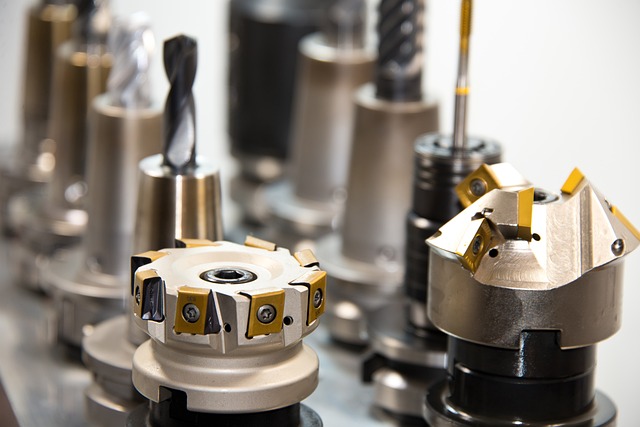
Setting up the CNC machine involves securing the workpiece on the worktable using clamps or fixtures to prevent movement during machining. The appropriate cutting tools are installed in the machine’s spindle or tool changer. For a CNC machining center producing multiple parts, tool changers automatically swap between drills, end mills, and reamers, enhancing efficiency. Calibration is also essential: the machine’s axes are zeroed to ensure the tool starts at the correct position relative to the workpiece.

The Core: CNC Machining Operations
With the CNC machine programmed and setup, the machining process begins. CNC machines can perform various operations:
Milling
In CNC milling, a rotating cutter removes material from the workpiece. The machine can move along multiple axes (X, Y, Z, and even 4th/5th axes for complex parts) to create flat surfaces, slots, holes, and 3D contours. For example, a CNC vertical mill can machine a plastic enclosure with precise cutouts for buttons and ports, ensuring a perfect fit for internal electronics.
Turning
CNC turning involves rotating the workpiece while a stationary tool shapes it into cylindrical forms. CNC lathes are ideal for producing shafts, bushings, and threaded parts. A CNC lathe can turn a steel rod into a precision motor shaft, complete with threads and grooves, in a single setup.
Drilling and Tapping
CNC drilling machines create holes with high accuracy, while tapping operations cut internal threads. For a CNC-machined engine block, the process includes drilling dozens of holes for bolts and coolant passages, each positioned with millimeter - level precision.
Throughout the process, the CNC machine follows the G-code strictly, maintaining tolerances as tight as ±0.01mm. Sensors monitor tool wear, temperature, and vibrations, with some advanced machines adjusting parameters in real-time to maintain quality.

Quality Control and Post-Processing
After machining, parts undergo rigorous quality control. Operators use calipers, coordinate measuring machines (CMMs), or optical scanners to check dimensions against the CAD model. For example, a CNC-milled medical implant is scanned to ensure it matches the patient’s unique anatomy within strict tolerances.
Post-processing steps enhance the part’s functionality and appearance:
- Deburring: Removing sharp edges from CNC-machined parts.
- Heat Treatment: Hardening steel components on a CNC lathe through quenching and tempering.
- Surface Finishing: Anodizing aluminum parts or plating steel components for corrosion resistance.
- Assembly: Combining multiple CNC-machined parts into a final product, such as assembling CNC-turned gears into a transmission.

The Benefits of CNC Processes in Manufacturing
The CNC process offers distinct advantages:
- Precision: CNC machines repeat the same process identically, ensuring consistent quality batch after batch.
- Efficiency: Automated tool changes and continuous operation (even lights-out manufacturing) reduce downtime.
- Flexibility: A single CNC machine can produce different parts by simply loading a new G-code program, ideal for small batches or custom products.
- Complexity: CNC machines can create intricate shapes, like turbine blades or aerospace brackets, that are impossible with manual tools.

Conclusion
The CNC process in manufacturing is a blend of design precision, programming expertise, and CNC machine automation. From CAD models to finished parts, each stage leverages CNC technology to deliver accuracy, efficiency, and reliability. As industries demand ever-more complex and high-quality components, the CNC process—driven by advanced CNC machines—will remain at the forefront of modern manufacturing, enabling innovation across aerospace, automotive, medical, and beyond.


What Is A 5-axis Machining Center
What Is The Role of a Process Engineer In Manufacturing
Related Article

Poor surface finish, inconsistent dimensions, vibration, or an unexpected stop doesn’t always mean something is wrong with your CNC lathe. Worn tooling, poor workholding, and unsuitable cutting parameters can cause many of the same symptoms.
Common problems and solutions for CNC lathes

How to Choose a CNC Lathe for Shaft Machining: A Guide to Types, Models, Materials, and Machining Capacity

